


The Secret Behind Matilda
I never asked to be a mystery. But if the Hotel Matilda carries my name, the least I can do is tell you why.
My aunt, Matilda Geddings Gray, collected art the way other women collect necklaces and pearls, or shoes and handbags: with obsession, with taste, and with enough money that no one dared tell her no. She was the one who infected me with that peculiar love of art and artists, and it was because of her that I was named Matilda. I even know it was she who decided my fate: that I would travel the world, even after my own death.
She was also the one who had Diego Rivera eating out of her hand, literally and figuratively. They became close friends, protective of one another, the kind of bond that in Mexico they call a “bonita amistad,” and that in Louisiana, I suspect, is something closer to being partners in crime.


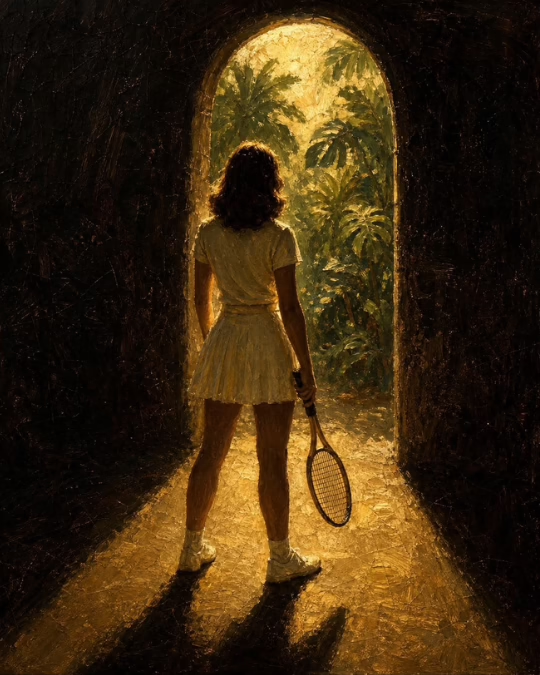
So when I was about to turn sixteen, it was no surprise that Diego Rivera painted me. What was strange was that he painted me three times. The first time, I posed in a yellow dress, flat shoes, and a racket in hand, as if tennis were the only thing that mattered about me at that age. Manicured hands, pedicured feet, a well-bred girl unwittingly portraying her family’s money. The second time was at my birthday party, coming down the staircase of the house in a pink princess-cut dress, as if I were the little doll on top of the cake.
Many say my aunt disliked both portraits, but that’s a myth. The one who was never quite satisfied was Diego Rivera, her friend. I never knew exactly what Diego was searching for in me, but it was after my sweet sixteen that he would try one last time. By the third portrait, I was no longer a girl with a racket, nor a princess in a pink dress.
I was a serene, steadfast, almost symbolic amazona: slender, tall, my blond hair waved in the style of the era. I wore white — a tennis ensemble with faux pockets over the chest and sharply expressive French sleeves that gave shape to my figure, now a clear reflection of my beauty, an exercise in Diego Rivera’s ideal.
What lingers is the starched precision of the outfit: its pleats, its buttons, the waistband at my hip, my posture upright and assured, nearly resolved to smile, my lips painted red to match the polish on my toenails — not my fingernails. In my right hand I held a long wooden bow and an arrow: solemn and elegant, yet daring, thanks to my captivating blue eyes and long legs. My feet appear bare, but I was actually wearing flesh-colored sandals. No jewelry, no earrings — nothing to compete with what he wanted to show: that I was no longer a child.
That is the portrait — well, the replica — that greets guests today in the lobby of the hotel bearing my name. The original is off touring somewhere, as things tend to do once they no longer fully belong to us, once someone has declared them heritage.

What almost no one knows is that this last portrait came only a few years after Diego found himself in the worst trouble of his career: refusing to erase Lenin from a mural in the heart of Rockefeller Center. They say Nelson Rockefeller asked him ever so politely. Diego refused with equal stubbornness. They covered the mural with tarps, threw him out of the building, and months later, at night and in secret, a crew of workers reduced it to dust with jackhammers.
And yet there I was, six years later, posing for him on that trip to San Francisco: the Golden Gate International Exposition of 1940, organized by Timothy Pflueger, an influential architect who understood that scandal sells. And so it was that the very country that had cast Diego out rolled out the red carpet for him to paint, live, a ten-panel mural: Pan American Unity. Roosevelt needed allies against the Nazis, Pflueger knew that morbid curiosity drew crowds, and Diego — more fox than rebel by then — painted factories, bridges, and Henry Ford in place of Lenin, with Hitler and Mussolini appearing only faintly, as a warning. Everybody won.
And while he painted that “wedding” between the art of the north and the south, another wedding took place — smaller, but no less memorable: Diego and Frida’s second marriage, on December 8, 1940, on that very same trip to San Francisco. I wasn’t invited, but I’ve always thought my third portrait and that wedding shared something: both were second chances no one saw coming.
What the walls of the old Hotel Jacaranda still whisper is this: that there were three versions of me, not one.
That the one you see is merely the ending of a longer story. And that somewhere, in a storeroom you will never know, the other two Matildas are still waiting — the one with the racket, and the one turning sixteen — holding onto the secret of why neither of them was ever enough.

Stay tuned
Our next volume tells the story of Nacho Rodríguez Bach and his art in San Miguel de Allende. And very soon, I’ll share the story of a piece in constant motion that now lives in the hotel’s reception. That one has a story too, and I’m certain you’ll love it.
With love,
Matilda